

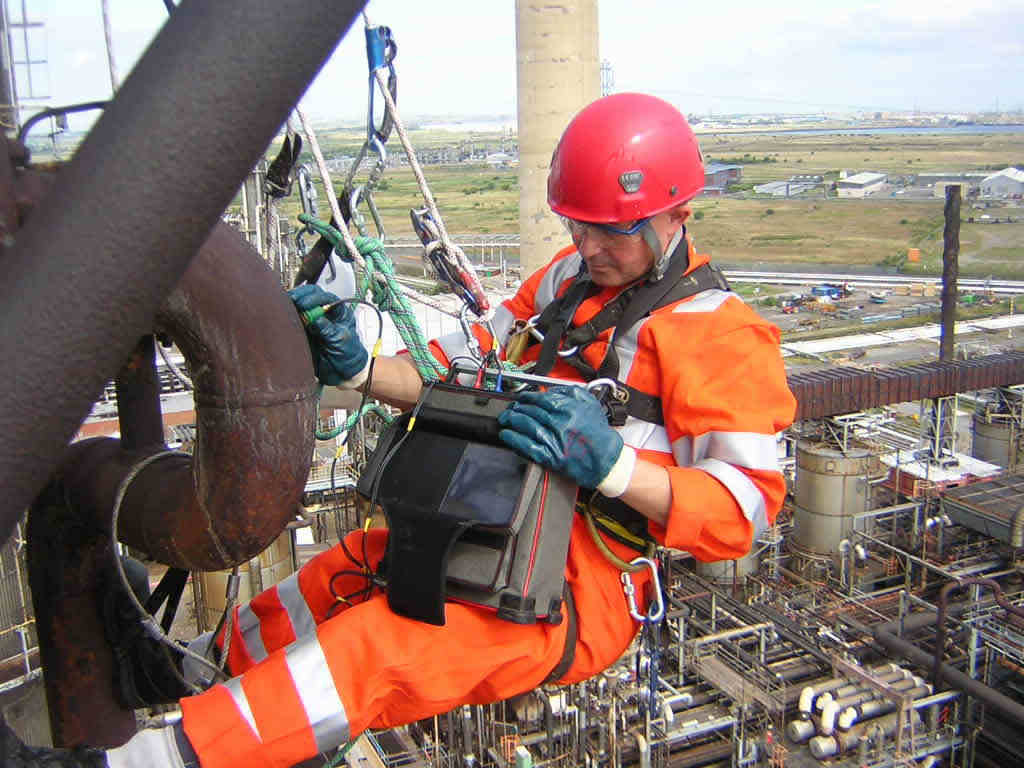
RNDT has NDT professionals that are recognized worldwide as leaders in the field of nondestructive testing. We have several professionals that have been active in nondestructive testing for thirty plus years working in all industries. We can develop a nondestructive testing technique for you on your product. Fill out a request form and we will contact you within 24 hours.
Nondestructive testing (NDT) is a wide group of analysis techniques used in science and industry to evaluate the properties of a material, component or system without causing damage. Because NDT does not permanently alter the article being inspected, it is a highly-valuable technique that can save both money and time in product evaluation, troubleshooting, and research. Common NDT methods include ultrasonic, magnetic-particle, liquid penetrant, radiographic, remote visual inspection (RVI).
Have a question?
Talk to an RNDT Level III inspector for free.
Call 1-800-505-7638 today!
Nondestructive Testing for Weld Verification
Welds may encounter loads and fatigue during the product lifetime, and there is a chance that they may fail if they are not manufactured to proper specification. For example, the base metal must reach a certain temperature during the welding process, must cool at a specific rate, and must be welded with compatible materials or the weld may not be strong enough to hold the parts together, or cracks may form in the weld causing it to fail. The typical welding defects (lack of fusion of the weld to the base metal, cracks or porosity inside the weld, and variations in weld density) could cause a structure to break or a pipeline to rupture.
Welds may be tested using nondestructive testing techniques such as industrial radiography or industrial CT scanning using X-rays, ultrasonic testing, liquid penetrant testing, magnetic particle inspection. In a proper weld, these tests would indicate a lack of cracks in the radiograph, show clear passage of sound through the weld and back, or indicate a clear surface without penetrant captured within any cracks.
How can we help you?
Send us a message.